
98%
Placed
in 2025








The MSc Advanced Networking & Cyber Security programme at Brainware University is a 2-year postgraduate degree designed for students who want to build advanced careers in network security, ethical hacking, cyber defence, digital forensics, server administration, vulnerability assessment, penetration testing, and secure IT infrastructure management. Students searching for a master’s degree in cyber security, master of science in cybersecurity, MSc cyber security course, or masters in networking and cyber security can use this page to understand the course duration, eligibility, syllabus, fees, admission process, and career scope.
The programme is suitable for graduates with relevant academic exposure to Computer Science, IT, Mathematics, Physics, Electronics, Networking, or Cyber Security. Eligible students can apply for MSc cyber security admission 2026 through the Brainware University admission process.
The curriculum covers advanced networking, Linux system engineering, Windows server infrastructure, routing, cyber risk management, ethical hacking, vulnerability analysis, penetration testing, malware analysis, reverse engineering, steganography, biometric security, digital forensics, and incident response. Students also gain exposure to practical lab work, industry-oriented tools, cybersecurity simulations, and real-world problem-solving.
The MSc in Cyber Security applicants will find all admission-relevant information on this page, including programme overview, syllabus outline, career options, as well as learning benefits. Details concerning the course, eligibility and admission criteria are provided as well.

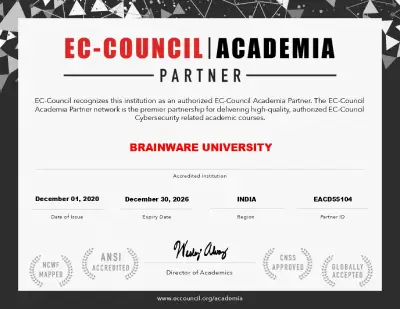
Brainware University proudly holds recognition as an authorised EC-Council Academia Partner, a testament to our commitment to delivering top-quality Cybersecurity academic courses authorised by EC-Council training and education.

The MSc Advanced Networking & Cyber Security programme is a 2-year postgraduate course that prepares students for specialised careers in cyber defence, network administration, ethical hacking, digital forensics, server security, and secure infrastructure management.
| Programme | Master of Science in Advanced Networking & Cyber Security |
|---|---|
| Duration | 2 years |
| Focus Areas | Advanced Networking, Cyber Security, Network Security, Ethical Hacking, Vulnerability Analysis, Penetration Testing, Digital Forensics, Malware Analysis, Reverse Engineering, Server Infrastructure, Routing, Cyber Risk Management, Cloud Security, Incident Response, Biometric Security, Steganography, and Secure System Administration. |
| Salary | Salary after MSc Cyber Security depends on technical skills, certifications, internship exposure, hands-on tool knowledge, job role, recruiter, and industry demand. Students with strong skills in penetration testing, SOC operations, network security, cloud security, malware analysis, and incident response can build stronger career profiles. It ranges from 5 LPA to 10 LPA starting. |
| Popular Job Types | Cyber Security Analyst, Network Security Engineer, IT Auditor, SOC Analyst, Incident Analyst, Cyber Crime Analyst, Penetration Tester, Ethical Hacker, Security Consultant, Cybersecurity Architect, System Administrator, Network Administrator, Malware Analyst, Digital Forensics Analyst, and Cybersecurity Manager. |
| Hiring Industries | IT Services, Cybersecurity Firms, Banking and Financial Services, Insurance, Telecom, E-commerce, Cloud Service Providers, Government Cybersecurity Units, Consulting Firms, Healthcare Technology, EdTech, Digital Platforms, Defence-Linked Technology Services, and Managed Security Service Providers. |
| Top Recruiters | Tata Steel, Wipro, Prime Infoserv, Teleperformance, Magic Bus India Pvt. Ltd., and other companies from IT, cybersecurity, network administration, digital infrastructure, consulting, and technology-enabled sectors. |
| Specializations | The programme develops advanced competence in Networking, Cyber Security, Ethical Hacking, Penetration Testing, Server Administration, Digital Forensics, Malware Analysis, Network Routing, Risk Management, Cloud Security, SOC Operations, and Cyber Defence. |
| Higher Studies | Graduates can pursue PhD in Cyber Security, PhD in Computer Science, PhD in Information Technology, advanced research in cyber forensics or network security, and professional certifications such as CEH, CompTIA Security+, CISSP, CISM, CCSP, OSCP, Red Hat, Cisco, cloud security, and SOC-related certifications. |
| Benefits | The programme offers hands-on lab training, advanced cybersecurity tools, exposure to EC-Council authorised academic learning, networking and server administration practice, cyber defence training, placement support, pre-placement preparation, value-added courses, and industry-relevant skill development. |
| Internship and Placement | Students receive internship guidance, project exposure, cybersecurity lab training, technical grooming, resume preparation, interview training, and placement support. Practical learning may include security audits, vulnerability testing, network configuration, cyber incident analysis, and tool-based cybersecurity practice. |
| Location | Brainware University, Barasat, Kolkata, West Bengal. |
| Approvals & Recognition | UGC Approved. |

Educational Qualification: Candidates must have completed graduation (in any discipline) with Computer/IT/Mathematics/Physics/Electronics as a subject. Alternatively, candidates with graduation in any discipline and a valid 1-year certificate from a government-registered organisation in Computer Science, IT, Networking, or Cyber Security are also eligible.
Minimum Marks: A minimum of 40% marks or an equivalent grade in the qualifying graduation examination is required.
A 5% relaxation in marks is applicable for reserved category candidates, as per government and university norms.
Entrance Criteria: Admissions are granted either on merit or through the Brainware Entrance Test (BET), ensuring equal opportunity for all aspiring candidates
Advance your skills in network engineering, cybersecurity operations, ethical hacking, and digital forensics with the M.Sc in Advanced Networking & Cyber Security—a programme crafted to deliver high-quality technical education at an affordable cost.This course provides access to advanced networking laboratories, enterprise-level routers and switches, virtualization systems, cybersecurity toolkits, simulation platforms, and expert faculty mentorship. Students gain real-world exposure through hands-on practical sessions, live security audits, industry projects, and research-driven learning. With a balanced investment in advanced academic training and practical cybersecurity applications, the programme prepares learners for successful careers in network security, penetration testing, cloud security, system administration, incident response, and secure infrastructure management.
Course Fees:Students searching for MSc cyber security course duration and fees should note that the MSc Advanced Networking & Cyber Security course duration is 2 years. The semester-wise fee structure should be checked from the official Brainware University admission office before applying, as fees may be revised as per university policy.
| Semesters | Semester 1 | Semester 2 | Semester 3 | Semester 4 | Semester 5 | Semester 6 | Semester 7 | Semester 8 | Semester 9 | Semester 10 | Total |
|---|---|---|---|---|---|---|---|---|---|---|---|
| Fees (INR) | 81700 | 81700 | 65700 | 40700 | 2,69,800 |
**Fees may be subject to change. Please contact us for details
Brainware University offers merit-based scholarships for top performers and financial aid for deserving students. Scholarships are available for high scorers in entrance exams, board results, and outstanding achievements in innovation or research. Visit our scholarship page for more details: https://www.brainwareuniversity.ac.in/scholarship.php
Artificial Intelligence is becoming central to modern cybersecurity. Organisations now use AI-based tools to detect threats, identify unusual behaviour, analyse malware, monitor networks, automate incident response, and strengthen cloud security. The MSc Advanced Networking & Cyber Security course introduces students to the role of AI in cyber defence, network monitoring, risk detection, and digital investigation.
Students learn how AI supports security operations through log analysis, anomaly detection, phishing identification, malware classification, intrusion detection, and predictive risk assessment. The programme also helps students understand the ethical and practical limits of AI in cybersecurity, including false positives, data privacy, model bias, and the need for human judgement.
This AI-driven exposure prepares students for future roles where cybersecurity professionals must work with intelligent monitoring systems, automated security tools, threat intelligence platforms, and AI-supported incident response workflows.

The AI learning spectrum in MSc Advanced Networking & Cyber Security connects cyber fundamentals with intelligent security applications. Students are introduced to how AI can be used across the complete cybersecurity cycle, from prevention and detection to investigation and response.
Key learning areas may include:
This exposure helps students understand how advanced cyber teams use automation and data-driven tools to improve speed, accuracy, and response quality.


Brainware University students from this programme have received opportunities with recruiters such as Tata Steel, Wipro, Prime Infoserv, Teleperformance, and Magic Bus India Pvt. Ltd. Graduates can explore roles in IT companies, cybersecurity firms, managed security service providers, telecom, BFSI, consulting, cloud service providers, and enterprise technology teams.


Cybersecurity is a high-demand field, and our graduates secure lucrative roles in ethical hacking, IT security, and network administration. Companies such as Tata Steel, Wipro, Prime Infoserv, Teleperformance and Magic Bus India Pvt Ltd hire Brainware University students for critical cybersecurity roles.
Placement support for the MSc Advanced Networking & Cyber Security programme focuses on preparing students for specialised roles in cybersecurity, network administration, ethical hacking, digital forensics, IT audit, SOC operations, and secure infrastructure management.


Brainware University has earned the prestigious AA+ rating in India’s Best Engineering Institutes by Careers360, a respected education analytics and ratings platform. This AA+ grade reflects the university’s strong performance in faculty quality, research output, infrastructure, academic rigor, and student outcomes. It positions Brainware among India’s leading emerging engineering institutions, recognised for delivering industry-aligned B.Tech and M.Tech programmes with consistent placement success. The Careers360 rating reinforces Brainware University’s credibility as a trusted destination for high-quality engineering education.

Brainware University has been ranked No. 1 Engineering College under a Private University in West Bengal in the IIRF Rankings 2026, reaffirming its position as a leading destination for BTech and MTech education in India. This prestigious recognition highlights the University's excellence in engineering education, industry-focused curriculum, research-driven learning, and strong placement performance.
The University's BTech programmes are designed to equip students with future-ready skills in emerging technologies such as Artificial Intelligence, Data Science, Cyber Security, Cloud Computing, IoT, and Core Engineering disciplines. Complementing this, the MTech programmes provide advanced technical knowledge, research opportunities, and industry exposure, preparing graduates for leadership roles in academia, research, and the corporate sector.

Brainware University is featured in the Times Higher Education (THE) Impact Rankings 2025, placing it among the globally recognised institutions committed to the United Nations Sustainable Development Goals (SDGs). As one of the few universities from West Bengal to achieve this distinction, Brainware demonstrates strong performance in areas such as quality education, innovation, industry partnership, sustainability, and community engagement. This ranking validates the university’s dedication to inclusive growth, responsible practices, and outcome-driven academics, strengthening its position as a progressive institution focused on long-term societal impact.

Brainware University has been recognised by The Times Group as one of India’s leading higher education institutions, earning distinctions as the Best Institute in Engineering (Placement), Best Law Institute, and Best Institute in MBA Studies. These accolades reflect the university’s strong academic framework, industry-driven curriculum, and consistent placement performance across disciplines. The Times Group’s recognition underscores Brainware University’s balanced excellence in technical education, legal studies, and management programmes, reaffirming its position as a trusted, multi-disciplinary university committed to delivering quality education and successful career outcomes.

Brainware University has been honoured as the Best Private University in West Bengal at the Times Now.in Business Excellence Awards (East) 2025, a prestigious recognition celebrating outstanding institutions that demonstrate excellence in performance, innovation, and student success. This award highlights Brainware’s sustained leadership in academic quality, cutting-edge infrastructure, industry partnerships, and high-impact learning outcomes. Being chosen as the top private university in the state reinforces Brainware University’s credibility as a trusted, future-focused institution committed to delivering world-class education and career-ready graduates.

Brainware University has been recognised as the Leading University in Infrastructure, Academics & Placement at the Times Business Awards West Bengal 2025. This honour highlights the university’s exceptional campus ecosystem, modern learning facilities, outcome-driven academic design, and consistently strong placement record across disciplines. The award affirms Brainware University’s position as a top-performing institution that blends quality education with industry relevance, offering students a future-ready environment that supports learning, innovation, and successful career pathways.

Brainware University has been honoured with the prestigious Zee 24 Ghanta Education Excellence Award 2026 for Best Industry Placement & Academic Infrastructure, continuing its legacy of excellence with consecutive wins in 2022, 2023, 2024, 2025, and now 2026. The university was also recognised in 2017 and 2018 for its innovative job-oriented academic initiatives, reaffirming its commitment to industry-ready education and academic excellence.


The MSc Advanced Networking & Cyber Security syllabus is designed to develop both networking expertise and cybersecurity capability. The curriculum covers system administration, routing, server infrastructure, cyber risk management, ethical hacking, vulnerability assessment, penetration testing, malware analysis, reverse engineering, digital forensics, and secure network operations.
Students learn through theory, labs, tool-based practice, projects, and industry-oriented assignments. The syllabus supports learners who want careers in network security, SOC operations, ethical hacking, digital forensics, IT audit, cyber risk management, and secure infrastructure administration.
The core foundations of the MSc Advanced Networking & Cyber Security syllabus help students build the technical base required for secure network and system administration. These subjects support practical understanding of computing infrastructure, security principles, server environments, routing, risk management, and cyber defence.
Core learning areas may include:
These areas help students understand how systems are built, how networks operate, and how security controls are applied in real IT environments.
The industry-driven advanced modules focus on specialised cybersecurity areas that are used in security operations, threat investigation, penetration testing, enterprise defence, and digital forensics.
Advanced learning areas may include:
These modules prepare students for roles in cybersecurity operations, network security, ethical hacking, digital forensics, security consulting, incident response, and cyber risk management.
| Semester | Course |
|---|---|
| Semester I | Computer Networks |
| Windows Server Infrastructure | |
| Core Hardware & Troubleshooting Lab | |
| Computer Networks Lab | |
| Windows Server Infrastructure Lab | |
| Python Programming Lab | |
| Network Penetration Testing | |
| Network Penetration Testing Lab | |
| Linux System Administration Lab | |
| Semester II | Research Methodology and Ethics |
| Enterprise Routing and Switching Technique | |
| Enterprise Routing and Switching Technique Lab | |
| Network Security and Cryptography / Blockchain / MOOC | |
| Privilege Escalation | |
| API Penetration Testing | |
| Security Operation Centre Management | |
| Professional Communication, Collaboration, and Career Skills | |
| Semester III | Active Directory Penetration Testing |
| Malware Analysis Using Digital Forensics | |
| Project | |
| Semester IV | Dissertation |
Please note that the syllabus is subject to modification. Visit our Syllabus page for the elective subject details and updated syllabus.

Graduates of MSc Advanced Networking & Cyber Security can explore corporate and private-sector jobs across IT services, cybersecurity firms, managed security service providers, telecom companies, banks, insurance companies, cloud service providers, e-commerce platforms, consulting firms, healthcare technology companies, and enterprise IT departments.
Popular corporate and private-sector job roles include:
Students with strong lab practice, internship exposure, certification readiness, tool knowledge, and report-writing ability can build better profiles for cybersecurity and networking careers.
Graduates of MSc Advanced Networking & Cyber Security can also apply for government and public-sector roles where network security, cyber investigation, IT audit, digital forensics, system administration, and information security skills are required. Opportunities may be available in government IT departments, cyber crime units, public sector banks, PSUs, research organisations, defence-linked technical units, digital governance projects, and regulatory bodies.
Candidates may need to qualify through competitive examinations, organisation-specific recruitment tests, interviews, technical assessments, or experience-based selection processes, depending on the role.
Career prospects after MSc Advanced Networking & Cyber Security are strong because organisations need trained professionals to protect networks, servers, applications, cloud systems, databases, and digital users from cyber threats. The programme prepares students for both defensive and investigative cybersecurity roles, along with network administration, IT audit, risk management, and security consulting opportunities.
| Area of Opportunity | Why It’s in Demand |
|---|---|
| IT Auditor | Compliance and Risk Assurance: Essential for performing independent examinations of an organization's IT infrastructure and security controls, ensuring they meet legal, regulatory, and internal policy standards. |
| Incident Analyst | Rapid Threat Response: Crucial for monitoring security alerts, investigating confirmed breaches, containing active attacks, and performing forensic analysis to determine the scope and cause of security incidents. |
| Cybersecurity Architect | Strategic Security Design: Highly demanded for designing and overseeing the implementation of the entire security framework, ensuring systems are inherently resilient, scalable, and aligned with enterprise-wide risk strategy. |
| Cyber Crime Analyst | Digital Forensics and Investigation: Needed by law enforcement, government agencies, and corporations to investigate cyber crimes, trace digital evidence, and link technical activities to malicious actors for legal action. |
| Cybersecurity Manager | Program Leadership and Governance: Essential for leading the security team, managing budgets, defining security roadmaps, and communicating risks to executive leadership, ensuring organizational security goals are met. |
| Cybersecurity Consultant | Specialized External Expertise: Hired to provide objective, high-level advice on specific security problems (e.g., cloud security, zero trust architecture), risk assessments, and compliance projects, filling critical knowledge gaps. |
Overall, MSc Advanced Networking & Cyber Security offers a focused postgraduate pathway for students who want careers in network security, cyber defence, ethical hacking, digital forensics, SOC operations, and secure infrastructure management. Students who combine academic learning with hands-on labs, internships, certifications, and continuous practice can build strong career prospects in India’s growing cybersecurity sector.
The job market for MSc Cyber Security graduates from 2025 to 2032 is expected to grow steadily as organisations increase investment in digital security, cloud protection, cyber risk management, digital forensics, network defence, and security operations. With rising cyber threats, companies need trained professionals who can protect systems, detect attacks, investigate incidents, and maintain secure IT infrastructure.
Key future trends include:
Between 2025 and 2032, students with hands-on cyber lab experience, internships, certifications, networking knowledge, and strong reporting skills will have better career prospects in India’s cybersecurity sector.

Students pursuing MSc Advanced Networking & Cyber Security at Brainware University gain advanced academic and practical exposure in cybersecurity, network administration, server infrastructure, ethical hacking, cyber forensics, and secure system management.
Key future trends include:
By the end of the programme, students should be able to assess network risks, identify vulnerabilities, analyse cyber threats, support incident response, manage secure infrastructure, and prepare for cybersecurity roles across private and public sectors.

The MSc Advanced Networking & Cyber Security programme benefits from lab-based technical learning that helps students connect cybersecurity concepts with practical implementation. Cybersecurity cannot be learned only through theory. Students need direct exposure to routers, servers, network environments, virtual machines, penetration testing tools, security monitoring systems, and forensic investigation methods.
The uploaded course draft mentions advanced networking laboratories, enterprise-level routers and switches, virtualisation systems, cybersecurity toolkits, simulation platforms, and a dedicated cybersecurity lab. Such facilities support practical learning in network configuration, Linux and Windows server infrastructure, vulnerability analysis, penetration testing, routing, malware study, incident response, and secure infrastructure management.
Brainware University’s association with EC-Council, Red Hat Academy, Cisco, IEEE student chapter, and TCS iON should be used to support this section after final verification from the university. These academic and knowledge partnerships can strengthen student exposure to certification-aligned learning, technical workshops, cyber defence practices, and industry-relevant training.


MSc Advanced Networking & Cyber Security admission 2026 at Brainware University is open for eligible graduates who want to build careers in cybersecurity, network administration, ethical hacking, digital forensics, server security, SOC operations, and cyber risk management. Students searching for MSc cyber security admission, MSc cyber security admission process 2026, or masters in cyber security eligibility can use this section to understand the application process, eligibility rules, entrance criteria, counselling, and direct admission options.
Applicants should review the course duration, syllabus, eligibility, fee structure, scholarship options, practical lab exposure, placement support, and admission requirements before applying.
Admission Criteria: Candidates applying for MSc Advanced Networking & Cyber Security must have completed graduation in any discipline with Computer, IT, Mathematics, Physics, or Electronics as a subject.
Alternatively, candidates who have completed graduation in any discipline and hold a valid 1-year certificate from a government-registered organisation in Computer Science, IT, Networking, or Cyber Security are also eligible.
A minimum of 40% marks or an equivalent grade in the qualifying graduation examination is required. Admission is subject to eligibility fulfilment, merit evaluation or BET performance, document verification, seat availability, and final approval as per university norms.
Application: Students can apply for MSc Advanced Networking & Cyber Security admission 2026 by filling out the enquiry or application form available on the Brainware University website. Applicants must enter their name, select Advanced Networking & Cyber Security from the course drop-down menu, choose their location, and submit a valid phone number and email ID.
Entrance Exam: Admission to MSc Advanced Networking & Cyber Security is granted either on merit or through BET, the Brainware Entrance Test, as per university admission guidelines.
Counselling: After application submission, eligible candidates are guided through the counselling process by the university admission team. Counselling helps students understand MSc cyber security eligibility, course duration, syllabus, fees, scholarships, lab exposure, certification-aligned learning, internship opportunities, placement support, and career scope.
Direct Admission: Direct admission to MSc Advanced Networking & Cyber Security may be available for eligible candidates as per university norms, subject to academic qualification, merit, BET requirement where applicable, seat availability, document verification, and admission guidelines.
Please follow the MSc Advanced Networking & Cyber Security admission procedure at Brainware University::


I am now a successful professional and started my career under the guidance of Brainware University with the precise training and placement support.
Samudranil MaityNetworking & Cyber Security
Academic support from faculty and collaboration between industry and academia worked more effectively in deciphering the interviews.
Sayantan Kumar LahaNetworking & Cyber Security

"Brainware students are professionally and technically well-informed as freshers. We are impressed with the level of confidence and positive attitude they demonstrated during their interviews."
Mr. Vaskar Bhattacharya Regional Head-East, Ginnisystems Ltd.
We always find competent and positive students who are almost ready to be professionals. We never get disappointed wherever we come for the recruitment. Well done Brainware University!
Ms. Srimoyee Mukherjee Manager HR Nature Technologies Pvt. Ltd.



The Department of Cyber Science & Technology has established itself as a hub of excellence in cybersecurity education through a series of impactful academic, industry, and professional development initiatives. The department has successfully organised flagship events such as SECCOM 2024, bringing together experts from NASSCOM, IBM, EC-Council, and leading cybersecurity organisations to expose students to the latest developments in cyber defence and digital security. The department has also conducted specialised workshops and seminars on ethical hacking, digital forensics, cybercrime investigation, cloud computing, cybersecurity management, and emerging security technologies, led by professionals from organisations such as EC-Council, PwC, IBM, Cognizant, and the West Bengal Cyber Crime Wing.
A notable achievement of the department is its strong industry-academia ecosystem, supported by collaborations with Cisco, Red Hat, EC-Council, CompTIA, CREST, ISOAH, GitHub, and OWASP, enabling students to gain industry exposure, certification opportunities, and practical cybersecurity training. Through initiatives such as BrainCon CTF competitions, Cyber Jaagrookta programmes, cyber awareness campaigns, industry visits, and career-oriented workshops, the department continues to nurture future-ready cybersecurity professionals equipped to meet the evolving challenges of the digital world.

A Masters in Cybersecurity can lead to a wide range of exciting and challenging careers in the field of information security. You could be developing security policies and procedures, and ensuring compliance with industry standards and regulations. You could assess security needs, develop security plans, and implement security measures or conduct research into new and emerging threats to information security. You could be a security architect who designs and develops secure computer systems and networks to protect against cyber threats. Or, you could be a Penetration Tester, also known as an ethical hacker, who is responsible for testing an organization's computer systems to identify vulnerabilities and weaknesses.
M.Sc ANCS stands for Master of Science in Advanced Networking & Cyber Security. The course focuses on advanced computer networks, cybersecurity principles, ethical hacking, penetration testing, cloud and server security, cyber forensics, and real-world threat management through hands-on labs, industry tools, and practical projects.
While both MSc Cyber Security and MSc Information Security programs cover similar topics, there are some differences between the two. MSc Cyber Security programs generally focus more on the technical aspects of security, such as network and systems security, while MSc Information Security programs cover a broader range of topics including policy, governance, and risk management.
An MSc Cyber Security program helps students develop skills such as risk assessment and management, vulnerability testing and analysis, cryptography, network and systems security, cyber forensics, ethical hacking, and incident response.
M.Sc. in Advanced Networking & Cyber Security is a postgraduate program that focuses on network security, ethical hacking, cybersecurity protocols, cloud security, and digital forensics.
Brainware University offers industry-driven training, expert faculty, hands-on lab experience, and globally recognized cybersecurity certifications, making it a top choice.
You need a B.Sc./BCA/B.Tech degree in Computer Science, IT, or related fields. Admission may be based on merit or entrance exams.
Core subjects include Network Security, Cryptography, Ethical Hacking, Cloud Security, IoT Security, Cyber Threat Intelligence, and Digital Forensics.
The program is 2 years long, divided into 4 semesters.
Graduates can work as Cyber Security Analysts, Network Security Engineers, Ethical Hackers, Cyber Forensics Experts, SOC Analysts, and Cloud Security Architects.
Entry-level salaries start from ₹6-8 LPA, while experienced professionals can earn ₹15-25 LPA or more.
Leading companies include IBM, Accenture, Infosys, TCS, Wipro, Palo Alto Networks, Cisco, and government cyber agencies.
Focus on penetration testing, network security, encryption methods, malware analysis, and hands-on experience with security tools like Kali Linux, Wireshark, and Metasploit.
Yes, ethical hacking is in high demand. Earning certifications like CEH (Certified Ethical Hacker) can boost career prospects.
Certifications like CEH (Certified Ethical Hacker), CISSP, CompTIA Security+, CISM, CCSP, and OSCP can enhance job opportunities.
Practice on platforms like Hack The Box, TryHackMe, and participate in Capture The Flag (CTF) challenges.
Languages like Python, C, C++, Java, and Bash scripting are crucial for automation, exploit development, and malware analysis.
Essential tools include Kali Linux, Wireshark, Metasploit, Burp Suite, Nmap, and Snort.
Include projects on penetration testing, internships, cybersecurity competitions, certifications, and experience with security tools.
Trends include AI-driven cyber defense, Zero Trust Security, Quantum Cryptography, Cloud Security, and IoT Cybersecurity.
AI is used for threat detection, malware analysis, security automation, and real-time anomaly detection.
Cloud security protects data, applications, and infrastructure from cyber threats in cloud environments.
Major threats include ransomware attacks, phishing, zero-day vulnerabilities, supply chain attacks, and social engineering scams.
Follow sources like The Hacker News, Cybersecurity & Infrastructure Security Agency (CISA), and participate in online cyber forums.